How to Read Food Labels When Managing Your Weight
Learning how to read food labels can make shopping more informed. It does not require finding a single perfect product or judging every food by one number. Start with a few comparisons that match what you actually want to know.
The explanations here refer to the U.S. Nutrition Facts label. Labels in other countries may use different formats.
Sources checked
2 min read
Start with the reference amount
Look at serving size and servings per container before looking at the rest. Nutrition amounts usually refer to that serving, and the package may contain several. A labeled serving reflects a reference amount, not a personal instruction about how much to eat.[1]
For a simple hypothetical example, suppose a package lists 120 calories per serving and contains two servings. Eating the full package would provide 240 calories. The arithmetic explains the label; it does not determine whether that amount suits your meal.
Compare similar amounts
Two products can look different because one reports a smaller serving. Compare equivalent amounts where possible. If you cannot make the comparison easily, do not assume the smaller printed number means the product is a better choice.
Look at the foods in the context of how you use them. A sauce, snack, and main meal are not interchangeable simply because their labels can all display calories.
Read more than calories
Depending on your needs, you might compare fiber, sodium, saturated fat, or added sugars. Total sugars and added sugars are not the same label category, and neither line alone describes the whole food.[1]
Choose one or two priorities that are relevant to you. If a clinician has given you a specific nutrition plan, use that advice rather than an online ranking of “best” foods.
Understand percent Daily Value
Percent Daily Value indicates how a nutrient in a serving relates to a daily reference amount. FDA describes 5% DV or less as low and 20% DV or more as high for a nutrient per serving.[2]
These are interpretation guides, not a requirement to total every label perfectly. They also do not make a 2,000-calorie reference diet your personal target.
Put front-of-package claims in context
Words such as “light,” “natural,” or “high protein” should not replace checking the actual label and ingredient information. Ask what is being claimed and whether it relates to your needs.
A food does not become a guaranteed weight-loss product because its packaging uses health-related language. Your broader eating pattern and circumstances still matter.
Practice with two familiar foods
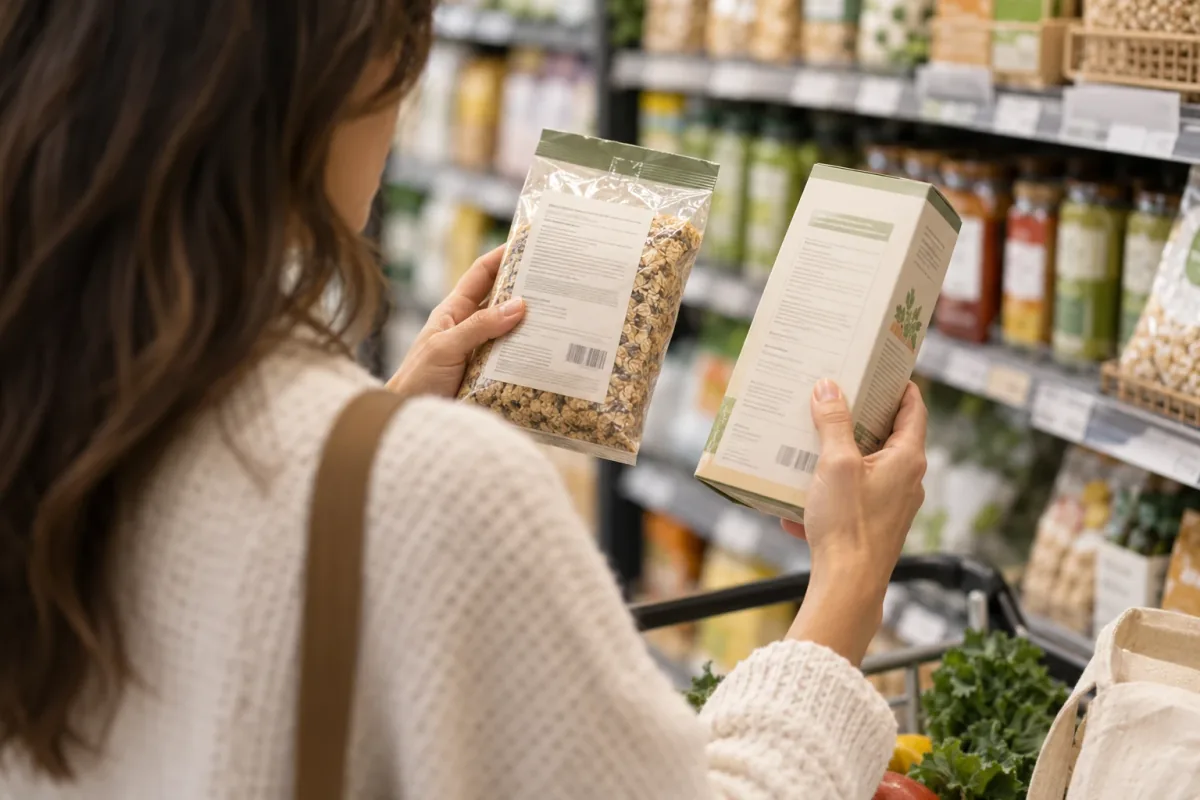
Pick two products you already buy. Compare equivalent serving amounts and one nutrient of interest. Record what you learned, then decide whether price, taste, accessibility, and nutrition make either option more useful for you.
Common questions
Should I always choose the lowest-calorie option?
Not automatically. Consider the food’s role in your meal and your overall needs rather than using one number as a universal score.
Does the label tell me exactly how to lose weight?
No. It provides product information. Read understanding portions and keep a short shopping list to turn comparisons into practical shopping choices.
About this article
General education for adults, based on the sources listed below. This article has not been medically reviewed.
This information is educational and is not a substitute for advice from your doctor or a registered dietitian. Read our health disclaimer and editorial policy. Spotted an error? Tell us.
Sources
FDA — How to Understand and Use the Nutrition Facts Label. Checked Oct 15, 2026.
FDA — The Lows and Highs of Percent Daily Value. Checked Oct 15, 2026.
Sources checked on October 15, 2026. Numbered references support the factual statements marked in the text. Practical scenarios and planning templates are original examples, not clinical study results.