How to Build Healthy Habits That Actually Stick
Most of us know at least some of the things we would like to do more often: eat more vegetables, walk more, drink more water, get to bed earlier. The hard part is rarely knowing what to do. It is doing it consistently, week after week, when life gets busy.
Research on habits offers a helpful insight: when you repeat a simple action in the same situation, it gradually becomes more automatic and takes less willpower. This guide shows how to use that idea in everyday life, and how to handle the days when things do not go to plan.
Sources checked
4 min read
How habits form
A habit is an action that is triggered more or less automatically by a cue, such as a time of day, a place or something you have just done. Habits form through repetition: each time you do the same action in the same situation, the link between the situation and the action gets a little stronger.
How long does that take? In a well-known study described in a review in the British Journal of General Practice, it took an average of about 66 days for a new daily habit to reach its peak level of automaticity, but there was a lot of variation between people and between behaviors. Simpler actions tended to become automatic sooner than more complicated routines.
Start small and specific
Big goals like "get healthy" or "eat better" are hard to act on because they do not tell you what to do today. Turning them into a small, specific action makes them much easier to start. The NIDDK suggests starting with small changes, such as walking for 10 minutes three times a week.
- Instead of "exercise more," try "walk for 10 minutes after lunch on weekdays."
- Instead of "eat more vegetables," try "add one vegetable to dinner." Our guide to building a balanced plate has ideas.
- Instead of "sleep better," try "put my phone on the charger in the kitchen at 10 p.m."
Use cues and habit stacking
Because habits are triggered by cues, it helps to deliberately pick one. A good cue is something you already do every day at a predictable time. Linking a new habit to an existing routine is often called habit stacking. A simple formula is:
"After I [existing routine], I will [new habit]."
- After I pour my morning coffee, I will fill my water bottle.
- After I finish dinner, I will go for a short walk.
- After I brush my teeth at night, I will set out tomorrow’s breakfast.
Try to keep the cue and the action the same each time. Consistency in the same context is what helps the action become automatic.
Shape your environment
Your surroundings can make a habit easier or harder. Small changes reduce the effort it takes to get started:
- Keep walking shoes by the door.
- Put a bowl of fruit or washed, cut vegetables where you will see them. See our practical snack ideas for more.
- Keep a water bottle on your desk.
- Plan meals for the week on paper or in a notes app so healthy choices are ready when you are tired.
Support from other people is part of your environment too. Asking a friend, family member or coworker to join you or check in can help you stay motivated.
Track your progress simply
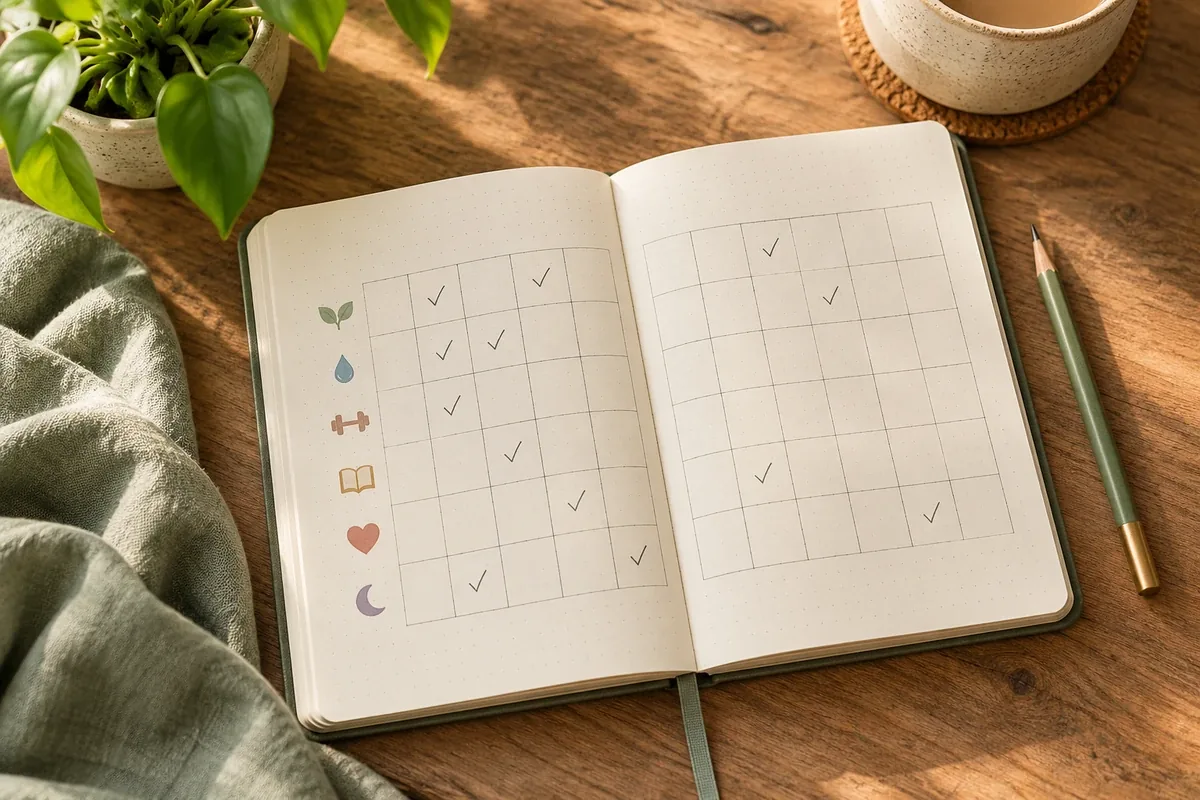
Tracking makes progress visible. It can be as simple as a check mark on a calendar each day you do your habit. The NIDDK also suggests noting how you felt, not only what you did, because noticing positive feelings can help a habit stick.
A simple checklist or calendar lets you check off daily habits and see your streaks over time. Celebrate milestones with rewards that support your goals, such as new walking gear, a book or time for a hobby.
Be kind to yourself when you miss a day
Everyone misses days. Illness, travel, work deadlines and family needs all get in the way. The good news is that in the habit research mentioned above, missing an occasional opportunity did not seriously disrupt habit formation. What matters more is returning to the habit. The CDC also notes that occasional setbacks are expected.
As the NIDDK puts it, a setback does not mean you have failed. Remind yourself why the habit matters to you, think about what got in the way, and plan for it next time. If bad weather stops your walk, for example, have an indoor option ready.
- Notice the miss without judging yourself.
- Ask what made it hard, and whether the habit needs to be smaller or moved to a different time.
- Do the smallest version of the habit at your next opportunity.
About this article
General education for adults, based on the sources listed below. This article has not been medically reviewed.
This information is educational and is not a substitute for advice from your doctor or a registered dietitian. Read our health disclaimer and editorial policy. Spotted an error? Tell us.
Sources
British Journal of General Practice (via PubMed Central, NIH) — Making health habitual: the psychology of “habit-formation” and general practice. Checked Oct 13, 2026.
National Institute of Diabetes and Digestive and Kidney Diseases (NIDDK) — Changing Your Habits for Better Health. Checked Oct 13, 2026.
Centers for Disease Control and Prevention (CDC) — Steps for Losing Weight. Checked Oct 13, 2026.