Ozempic for Weight Loss Without Diabetes: Understanding Off-Label Use
Can Ozempic be taken for the purpose of losing weight if a person does not have diabetes? Although a healthcare professional might prescribe it for this reason, there is an important point to note: Ozempic has not been approved by the FDA for use in weight management and therefore its use for weight loss is regarded as off-label prescribing.[1]
Ozempic injections have been given approval for use in the treatment of type 2 diabetes and in relation to certain cardiovascular and kidney risks among specific patient groups.[1] This does not mean that the drug can be used by people without diabetes who wish to lose weight.
To understand the off-label use of a drug, one has to go beyond considering the brand name. The appropriate questions to ask are whether there is evidence to support the treatment, whether an alternative that has been approved meets your requirements, what risks are involved, and how the care will be monitored.
The article is concerned with the use of Ozempic by injection in the United States and serves to give general information instead of making any specific treatment recommendation.
Published
Sources checked
10 min read

What Is Off-Label Use?
The FDA states that healthcare professionals can generally prescribe an approved drug for an unapproved use if they consider it to be medically appropriate. The fact remains, though, that the FDA has not established through its approval process that the drug is safe and effective for that particular use.
Prescribing off-label therefore differs from using a drug which has never been approved at all; Ozempic in fact is still an approved product even though the reason for prescribing it is outside the scope of its labeling.
Find out from your doctor why this approach has been chosen. Simply saying that 'this is commonly discussed online' does not count as an adequate explanation of how the treatment meets your medical needs.
Why Can Ozempic Have an Effect on Weight?
Ozempic has in it semaglutide, a substance which causes the glucagon-like peptide-1 receptors, commonly referred to as GLP-1 receptors, to be activated.[1]
It supports the release of insulin when blood sugar levels are high, reduces the liver's excessive release of sugar, and slows down the emptying of food from the stomach. The drug also has an effect on appetite and on food intake, which helps to account for the possible weight changes during treatment.[1][2]
This doesn't mean that all individuals will lose the same amount of weight, and it also means that Ozempic isn't an appropriate choice for every person who is looking to lose weight.
The biological effects of a medication and its approved indications are related but not the same. Simply observing an effect on weight is not enough on its own to determine the right product, dose, or treatment plan for a person who does not have diabetes.
What Does the Research Indicate in People Who Don't Have Diabetes?
There is strong evidence to show that semaglutide can aid weight reduction in people who are eligible and do not have diabetes; it is necessary, however, to accurately identify the product and dose that were used in the research.[3]
In the STEP 1 trial 1,961 adults who were overweight or obese and did not have diabetes were enrolled; the participants received either weekly injections of semaglutide at a dose of 2.4 mg or a placebo, together with a lifestyle intervention, for a period of 68 weeks.[3]
The average reduction in body weight was about 14.9% for those receiving semaglutide and 2.4% for those on the placebo. Once again, these figures are group averages and not guaranteed results for any individual.[3]
It is important to note that this was a study involving a semaglutide weight-management program and it must not be presented as evidence that a typical Ozempic prescription will yield the same outcome.
If the headline talks about weight loss and Ozempic, verify whether the actual research involved Ozempic, another product containing semaglutide, or a different dose.
How Is Ozempic Different From Wegovy?
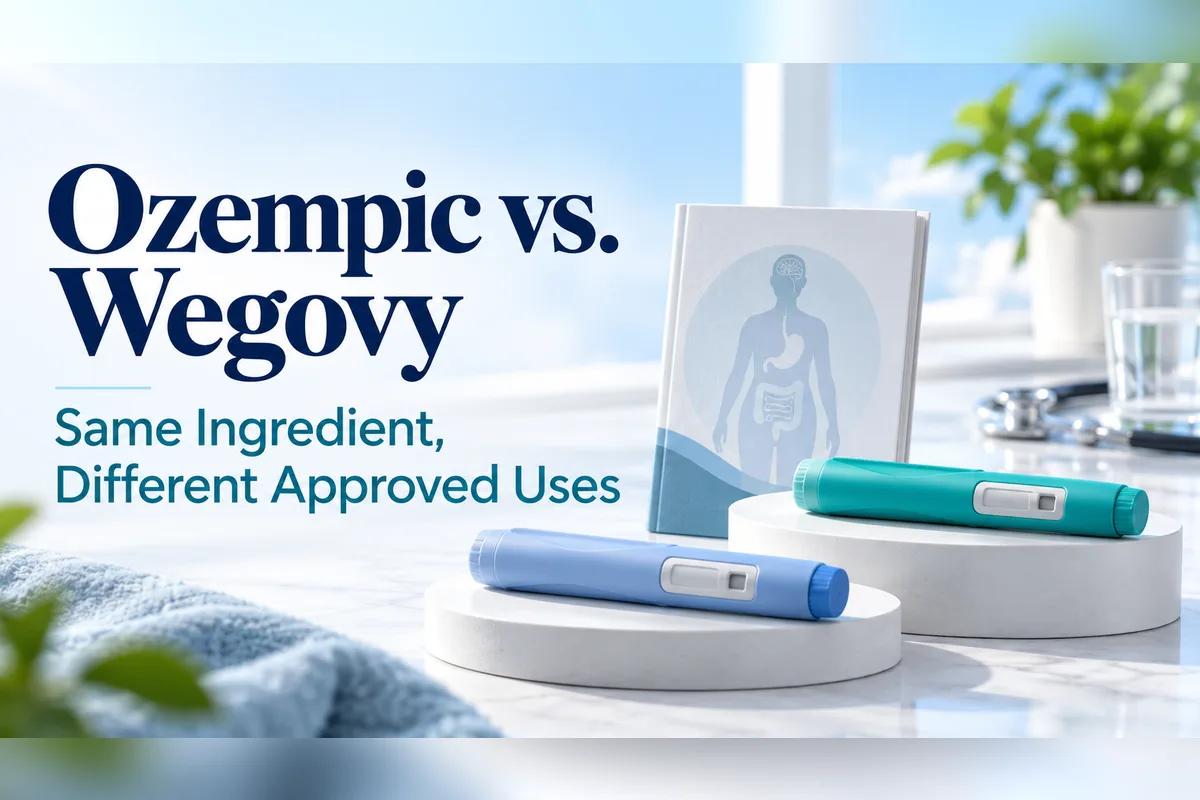
Wegovy also includes semaglutide, but it has received FDA approval for weight management in eligible patients.[2]
The labels state that the product helps to reduce excess body weight and assists in maintaining weight loss when combined with a reduced-calorie diet and increased physical activity; eligibility will vary according to the formulation and the patient group.[2]
You cannot share semaglutide and still treat it as if Wegovy and Ozempic are interchangeable since their approved uses and instructions for administration are different.
- Contains semaglutide?
Ozempic
Yes
Wegovy
Yes
- Specifically approved for use in weight management?
Ozempic
No
Wegovy
Yes, for patients who are eligible
- Is prescribing it for weight management off-label?
Ozempic
Yes
Wegovy
No, when used in accordance with its approved labeling
- Can you do it yourself?
Ozempic
No
Wegovy
No
| Question | Ozempic | Wegovy |
|---|---|---|
| Contains semaglutide? | Yes | Yes |
| Specifically approved for use in weight management? | No | Yes, for patients who are eligible |
| Is prescribing it for weight management off-label? | Yes | No, when used in accordance with its approved labeling |
| Can you do it yourself? | No | No |
If your primary aim is weight management, you should consider why Ozempic is being looked at rather than one of the approved options—the response should be based on your particular situation and not treat the different brands as if they were the same.
Who Could Be Thought Suitable for Medication to Help With Weight Loss?
The fact that someone does not have diabetes does not mean that they won't need medication for obesity. Medicines for weight management are used in eligible individuals whether or not they have diabetes.[5]
The NIDDK states that the usual BMI criteria for adults are a BMI of 30 or a BMI of 27 in the presence of a weight-related health condition. Product-specific requirements and clinical judgment remain applicable.[5]
The evaluation also looks at the patient's medical history, any other medications, the potential benefits, the possible side effects, and the cost; BMI is included in the discussion but does not serve as the entire basis for the prescribing decision.[5]
These general criteria do not constitute an FDA-approved "Ozempic eligibility rule" for individuals who don't have diabetes; rather, they are intended to help establish a wider conversation regarding weight-management treatment.
Take your health goals with you when you have the discussion, mentioning the things you have already tried and the kind of support you require.
What Are the Primary Risks?
Even people who do not have diabetes may suffer medication side effects; just because one does not have diabetes doesn't mean that gastrointestinal or other safety issues are eliminated.
Common side effects of Ozempic are nausea, vomiting, diarrhea, constipation, and abdominal pain. If vomiting or diarrhea continue, this can lead to dehydration and may result in kidney problems.[1]
There are serious concerns such as pancreatitis, problems with the gallbladder, severe gastrointestinal symptoms, and allergic reactions. If severe abdominal pain persists it is necessary to obtain medical advice immediately. Emergency assistance should be sought if there is difficulty in breathing or if the tongue or throat swell.[1]
Ozempic includes a boxed warning concerning thyroid C-cell tumors that have been observed in rodents; however, it is not known whether or not it causes such tumors in humans. The drug should not be used by individuals who have either a personal or a family history of medullary thyroid carcinoma or of multiple endocrine neoplasia syndrome type 2.[1]
It is not a full safety checklist.
Can Ozempic Cause Low Blood Sugar in People Who Don't Have Diabetes?
It is particularly important to consider the risk of hypoglycemia when Ozempic is used in combination with insulin or drugs like the sulfonylureas; although the effect on insulin secretion is in part dependent on blood glucose levels, this does not mean that there is a zero risk.[1]
Make sure to let your doctor know about all the medicines you are taking. If you experience shaking, sweating, confusion, dizziness, or any other worrying symptoms, get professional advice rather than simply thinking that they are normal changes in your appetite.
Find out if glucose monitoring is suitable in your situation. Your clinician should be the one to put together your monitoring plan, not someone else who has used the same brand.
Pregnancy Plans and Upcoming Procedures Matter
It is important to talk about your plans for having a baby before starting treatment; the prescribing information for Ozempic recommends stopping the medication at least two months prior to trying for a baby since semaglutide stays in the body for a long time.[1]
Make sure to inform your surgical or anesthesia team that you are taking Ozempic before any procedure which involves anesthesia or deep sedation since it can have an impact on how quickly the stomach empties and this may affect the safety of the procedure.[1]
It is better to follow the specific instructions rather than decide on a stopping schedule yourself.
Even if the prescription is primarily meant to deal with weight, these conversations should form part of routine treatment planning.
What Takes Place When Treatment Ceases?
Managing weight might involve the need for ongoing care rather than just a short-term course of medication.
In the STEP 1 extension, the participants who stopped both semaglutide 2.4 mg and the structured lifestyle intervention regained, on average, about two-thirds of the weight they had previously lost in the following year.[4]
The finding applies to a particular study group and treatment plan and cannot be used to predict exactly what will occur when any individual stops taking Ozempic; furthermore, the cessation of lifestyle support is something that should be taken into account when interpreting the results.
Before you begin, consider how the long-term plan would appear. Talk over the necessary follow-up, affordability, nutrition support, and any possible changes to the treatment if side effects or access turn into a problem.
Will Insurance Provide Coverage for Ozempic if You Don't Have Diabetes?
It would be wrong to suppose that just because a prescription has been obtained it will necessarily be covered.
The rules concerning insurance and the conditions of savings programs will vary according to the product, the diagnosis, and the particular plan; moreover, the manufacturer's offers also come with eligibility restrictions and may be subject to change.
The advertised price might be subject to certain conditions or could only apply for a limited time. It is necessary to check the latest terms rather than depending on an old screenshot or a social media post.
Find out from your insurance company if the prescribed use is covered, whether you need prior authorization, and what your continuing cost will be, and ask for a pharmacy quote before deciding on the treatment.
If no coverage is available, then it is better to talk about approved alternatives and other forms of care rather than assuming that the only option is an unverified online seller.
Buying Semaglutide Online: Important Differences
Getting an off-label prescription for Ozempic, which is an FDA-approved drug, is different from purchasing a product that is not approved but is marketed as semaglutide.
The FDA has warned that GLP-1 products which have not received approval do not have their safety, effectiveness, and quality examined by the agency before they are marketed, and it has expressed concerns regarding dosing errors, fraudulent products, and other issues.[6]
Compounded semaglutide must not be offered as a generic version of Ozempic that has been approved by the FDA. The FDA recommends that people get a prescription from a healthcare professional and use a pharmacy which is licensed in their state.[6]
Before you buy it, make sure you know precisely which product and pharmacy you are getting. A seller who omits the medical evaluation or supplies unclear information about the product is not offering an acceptable alternative to supervised care.
Questions to Ask Before Considering Off-Label Ozempic
An appointment that is useful should enable you to understand both the proposal and its alternatives, so you might consider asking:
- Can I have Ozempic recommended for my case?
- What is the evidence for this particular application and version?
- Would it be suitable to use an approved weight-management medicine?
- What benefits and side effects will we keep an eye on?
- What would cause us to alter or cease treatment?
- What measures will we take to control costs and ensure continued access?
- What kind of nutritional and activity support is available?
- When symptoms do develop, whom should I contact?
The NIDDK stresses that medication for weight management should be taken into consideration together with ongoing support for lifestyle changes and a personal evaluation of the benefits and risks.[5]
It is not necessary for you to bring a favorite brand; instead, please provide your objectives, any concerns you may have, your medical history, and your questions. You should request a clear explanation of how the suggested treatment meets your needs and what the follow-up will consist of.
About this article
General education for adults, based on the sources listed below. This article has not been medically reviewed.
This information is educational and is not a substitute for advice from your doctor or a registered dietitian. Read our health disclaimer and editorial policy. Spotted an error? Tell us.
Sources
FDA label via DailyMed — Ozempic (semaglutide) injection: Prescribing Information and Medication Guide. Checked Oct 20, 2026.
FDA label via DailyMed — Wegovy (semaglutide) injection and tablets: Prescribing Information. Checked Oct 20, 2026.
New England Journal of Medicine (2021), via PubMed — Wilding et al. Once-Weekly Semaglutide in Adults with Overweight or Obesity (STEP 1). Checked Oct 20, 2026.
Diabetes, Obesity and Metabolism (2022), via PubMed — Wilding et al. Weight regain and cardiometabolic effects after withdrawal of semaglutide: The STEP 1 trial extension. Checked Oct 20, 2026.
NIDDK — Prescription Medications to Treat Overweight & Obesity. Checked Oct 20, 2026.
U.S. Food and Drug Administration — FDA’s Concerns with Unapproved GLP-1 Drugs Used for Weight Loss. Checked Oct 20, 2026.
Source links checked October 20, 2026. Numbered markers identify support for factual statements. STEP 1 studied semaglutide 2.4 mg (the Wegovy dose) in adults without diabetes; its results are group averages, not predictions for an individual or for a typical Ozempic prescription. This article is educational information, not a prescribing recommendation.